Alcohol may still be served
With strict segregation maintained throughout the facility, non-halal food may continue to be served to non-Muslim customers.
Muslim Friendly Certification
Halal Certification for Japan (Muslim Friendly) is MPJA’s own scheme for restaurants and accommodation in Japan. Designed for an environment where fully halal operations may be difficult, it is recommended by JAKIM, a Malaysian federal government agency. With appropriate controls, businesses can continue their existing operations while giving Muslim customers a clear basis for choosing them.
Our team, including Japanese Muslim staff, handles enquiries in English and Japanese.
Fit Check
Facilities suited to Halal Certification for Japan (Muslim Friendly)
Other schemes or services may apply
Muslim Friendly Basics
A Muslim-friendly environment provides the information and facilities Muslim customers need for meals and prayer. At restaurants in particular, appearance alone cannot tell a customer whether food is halal. Pork-derived ingredients such as lard, gelatine and stock, or alcohol in mirin, cooking sake and wine vinegar, cannot be identified by sight.
What matters to Muslim customers is being able to check whether something is halal. Clear information about halal practices, ingredients and prayer spaces helps create a Muslim-friendly environment.
Pain Points
One difficulty when eating out is not knowing what a dish contains. Even where halal options exist, customers may avoid them if they cannot verify the ingredients.
Another consideration is prayer. Muslims pray five times a day. A small, clean space can make a significant difference to their stay.
Language is also a consideration. Perfect English is not necessary. Clear ingredient information and an honest response when staff do not know an answer help customers make informed choices.
Market
The number of Muslim visitors needing halal food and prayer facilities is growing significantly. Japan has more than 100 mosques, and Muslim-friendly provision is expanding. Many businesses have yet to make their provision clear. Businesses that communicate it can make themselves easier for Muslim customers to identify and choose.

The growing number of Muslim foreign workers is one reason demand for halal certification is increasing in Japan. Countries with Specified Skilled Worker cooperation agreements include Indonesia, Bangladesh, Pakistan and Uzbekistan. Indonesia is the second-largest nationality group, with 86,523 workers as of the end of December 2025 (Immigration Services Agency of Japan). Together, workers from Muslim-majority countries under this scheme number more than 90,000. Their employers, food manufacturers and nearby restaurants need to consider religious dietary requirements. MPJA certification indicates that products or services meet the applicable requirements and can contribute to a welcoming environment.
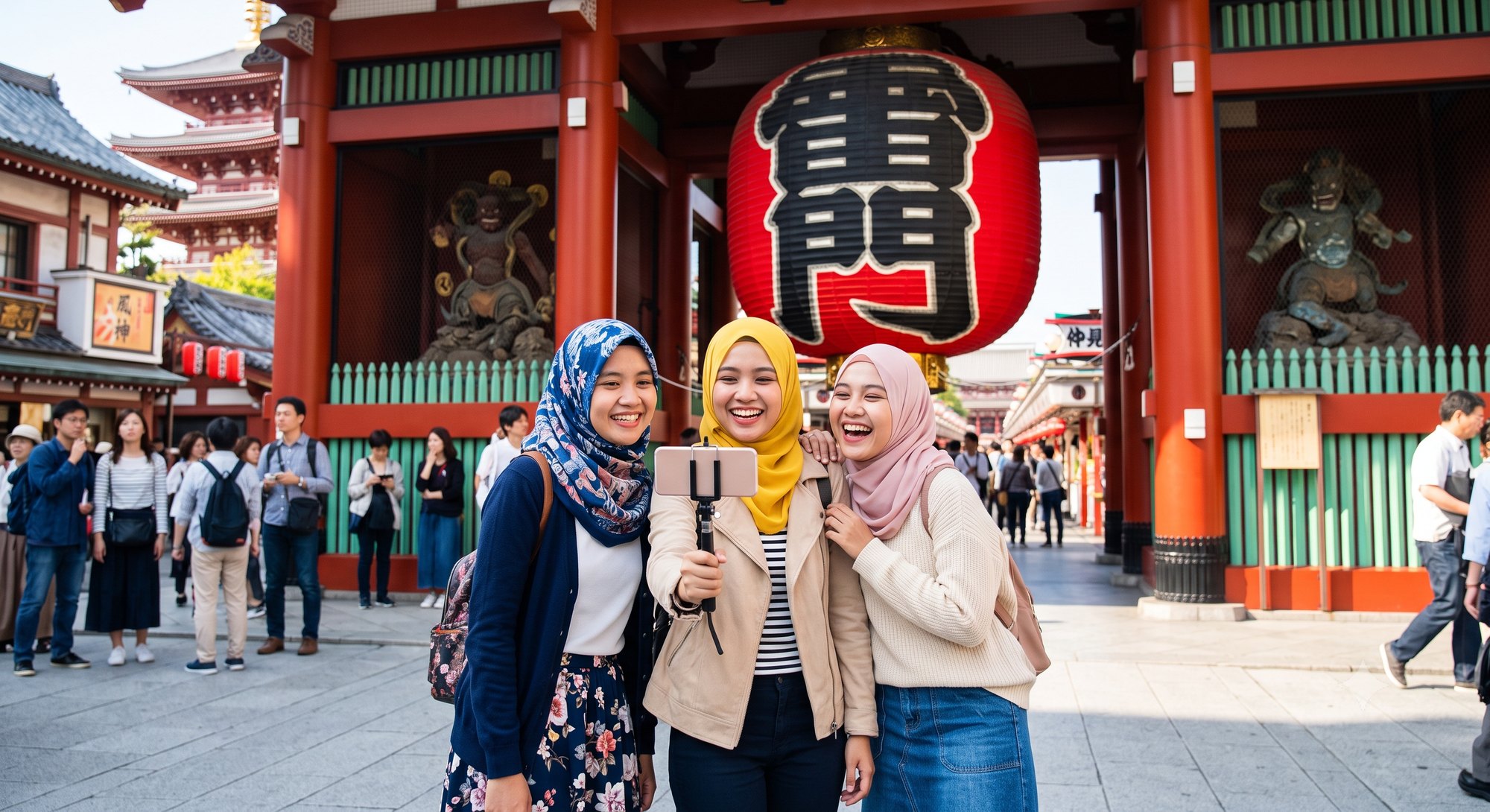
Halal provision in Japan is closely connected with welcoming Muslim visitors from markets including Malaysia, Indonesia and Singapore. Being able to choose certified halal meals with confidence is one factor in their travel decisions. More reliable halal provision can make Japan a more accessible destination.
Sources: Hirofumi Tanada, Japan’s Muslim Population 2025; Japan National Tourism Organization (JNTO), Visitor Arrivals by Nationality and Month; DinarStandard, State of the Global Islamic Economy Report 2024/25
Key Facts
Serving alcohol or having no Muslim employees does not, by itself, prevent certification. These are common misconceptions.
With strict segregation maintained throughout the facility, non-halal food may continue to be served to non-Muslim customers.
Employing Muslim staff is not a mandatory condition for certification. Appropriate management arrangements can meet the requirements.
Practical standards designed specifically for restaurants and accommodation.
The scheme is recommended by JAKIM, a Malaysian federal government agency, while being adapted to Japan's business environment.
In Practice
Clearly identify dishes containing pork or alcohol. English menus are one option. Not every menu item needs to be halal; what matters is offering clearly identifiable choices that Muslim customers can eat with confidence.
Separate preparation of meals for Muslim customers from non-halal ingredients. The required extent of dedicated utensils and areas is assessed against the premises and equipment during the meeting and site assessment.
A small, clean space is sufficient. Even an area roughly the size of one tatami mat can be helpful.
Ingredient information that customers can point to helps communication even where staff are not confident in English.
These are general principles. We explain the specific requirements under the certification standards at the meeting.
Requirements
What You Get
Certification helps customers identify places where they can eat or stay with confidence. This can contribute to visitor satisfaction and recommendations.
Where few nearby businesses cater for Muslim customers, the certification mark helps visitors identify your provision.
Welcoming customers with different needs contributes to a business’s reputation. Certification makes its assessed practices visible.
MPJA’s JAKIM recommendation and independent assessment provide a documented basis for the certification mark, beyond a business’s own declaration.
The certification mark and information about your business help Muslim customers understand what you offer.
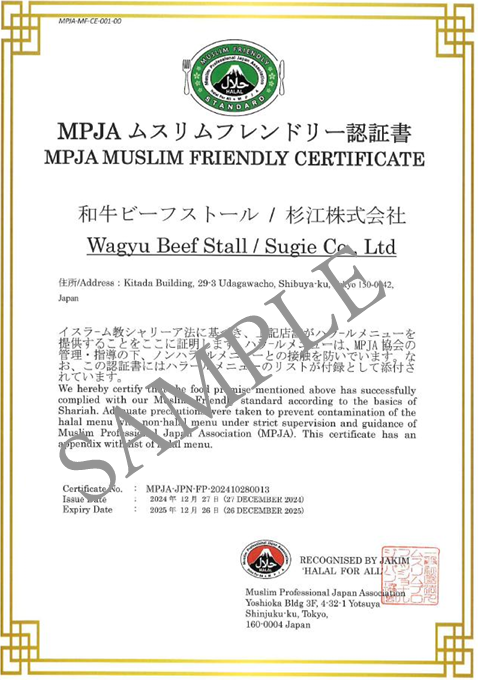
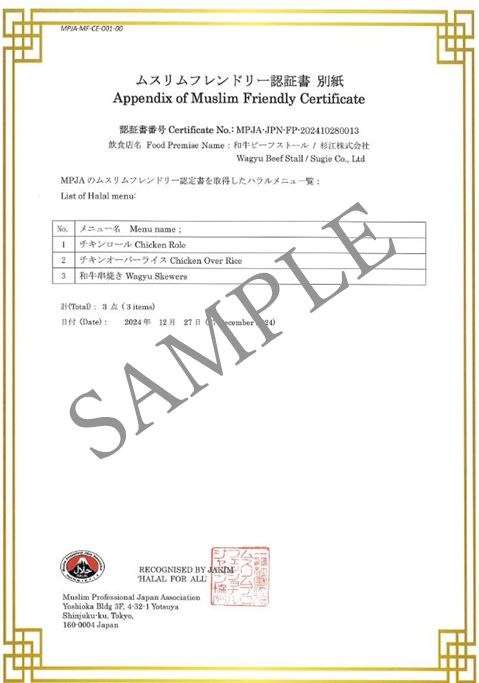
Certified businesses receive a main certificate and an annex listing the halal menu items covered.
Flow
We explain each stage at the meeting.
Timeline & Cost
The certification process generally takes up to about three months. Developing halal menus in-house typically takes around two to three months. Using halal-certified processed foods, such as retort-pouch curry or hamburger steaks, typically takes around one to one-and-a-half months, following verification of certification for the main products and assessment of side dishes. Assessment fees vary according to the number of ingredients requiring review.
Audit Documents
The audit document list is published here so you can understand the requirements in advance.
Difference
Japan has halal logos that do not hold recognition from a public authority. A business’s own practices may be well intentioned, but customers need information they can verify. Muslim Friendly certification is issued by MPJA, recommended by JAKIM, a Malaysian federal government agency. MPJA assesses the business as an independent third party so that customers can understand its halal practices. This assessment distinguishes certification from a business’s own declaration.
The learning required for Muslim Friendly operations is available through HalaliO — On-demand Halal Learning (app.halalio.ai).

MPJA Representative Director Akmal Abu Hassan came to Japan at 19 as a Malaysian government-sponsored student. After graduating from Gunma University, he worked at the Bank of Tokyo-Mitsubishi. He later worked on economic exchange between Japan and Malaysia at Malaysia’s Ministry of International Trade and Industry (MITI) and the Malaysia External Trade Development Corporation (MATRADE). He received a Malaysian government award in 2012.
As a Muslim with experience of Japanese business and public administration, he responds directly to enquiries in English and Japanese. You are welcome to ask about halal even if you are unsure where to begin.
Read our Representative Director’s backgroundFAQ
Yes, provided strict segregation is maintained within the facility.
Yes. Employing Muslim staff is not a mandatory certification requirement; appropriate management arrangements can meet the requirements.
This may be possible with segregation controls. We confirm the details at the meeting.
This depends on the facility. We explain the applicable requirements after a meeting and site assessment.
No. Ingredient information on menus can help customers communicate by pointing. We can explain the information that signs and menus need to convey at the meeting.
The certification process generally takes up to about three months. Assessment fees vary according to the number of ingredients requiring review. We explain the fees and scope after discussing your current arrangements.
The scope, standards and purpose differ. Halal Admin is for manufacturing and export; Muslim Friendly is for restaurants and accommodation. See Halal Certification for Export (Halal Admin) for details.
No. Halal requirements mainly concern food, ingredients and the processes used to prepare and serve them. Transport and bedding themselves do not need to be made halal, and Muslim Friendly certification does not require this.
Display the certification mark and share information about your business. For practical enquiries about reaching customers, contact Business Support (free consultation).
Yes. We can explain certification requirements and the assessment process before you apply. Please use the contact form to get in touch.
MPJA is a halal certification body established in 2013. It has mutual recognition with bodies including Malaysia’s JAKIM, Indonesia’s BPJPH and Thailand’s CICOT. Visit About MPJA for information about the association and its Representative Director.
About MPJATerms
Contact
Tell us about your business. We can explain the applicable certification requirements and assessment process.
ContactWhy MPJA