Mutual Recognition
Mutual recognition with an Indonesian government agency since 2024.
In 2024, MPJA obtained mutual recognition with BPJPH, Indonesia’s government agency for halal product assurance. This page explains BPJPH’s role and what recognition means as halal certification becomes mandatory in Indonesia.
About mutual recognition and BPJPH
Mutual Recognition
What is mutual recognition?
Mutual recognition is an arrangement in which certification bodies recognise each other’s assessment standards and accept certificates without recertification. Under this framework, MPJA certification is accepted in Indonesia within the recognised scope.
About BPJPH
What is BPJPH?
BPJPH (Badan Penyelenggara Jaminan Produk Halal, the Halal Product Assurance Organizing Agency) is the Indonesian government agency established to centralise and streamline halal certification, ensure compliance with Islamic law and strengthen Indonesia’s position in the global halal industry. Halal certification was previously managed by MUI, the Indonesian Ulema Council. BPJPH was established under the Halal Product Assurance Law No. 33 of 2014 as part of a government-led certification system with a statutory basis.
History & Mandate Schedule
BPJPH’s history and mandatory certification
BPJPH formally began halal certification operations on 17 October 2019 under Government Regulation No. 31 of 2019. Mandatory halal certification, initially scheduled for 17 October 2024, was extended under Government Regulation No. 42 of 2024 to 17 October 2026. On 16 October 2026, the government announced that the requirement for imported food and beverages will apply from 18 October 2028, pending publication of the formal regulation.
As of October 2024, BPJPH had mutual recognition agreements with 52 foreign halal certification bodies (LHLN) in 24 countries, including MPJA.
Plan your exports around the applicable certification requirements. Please confirm the latest timing for your product category in a consultation.
Responsibilities
BPJPH’s role
- Regulating international halal trade
- Accrediting halal inspection bodies (LPH)
- Issuing halal certificates
- Enforcing regulations
Certification Scope
MPJA’s recognised certification scope
BPJPH’s recognition of MPJA covers the following five product scopes. Eligibility is checked individually through product classification and document review.
- FoodFood and related raw materials
- BeveragesBeverages and related raw materials
- CosmeticsCosmetics and personal care products
- DrugsMedicines within the recognised scope
- Use GoodsConsumer products within the approved product classifications
BPJPH’s recognition is limited to these five scopes. Slaughtering, logistics and other areas outside them are not covered by this recognition.
What This Enables
What this recognition enables businesses to do
- Export to Indonesia with MPJA certification, without recertification within the recognised scope
- Meet applicable requirements through the mutual recognition framework as mandatory certification is introduced
- Receive guidance in English or Japanese on SJPH (the Halal Product Assurance System)
- The Indonesian importer or authorised representative registers the foreign halal certificate through SIHALAL before products can be placed on the market.
Documentation
Supporting documents
MPJA was recognised by MUI, the Indonesian Ulema Council, from 2015, and has been recognised by BPJPH since 2024. Its relationship with Indonesia predates the transition from the MUI system to BPJPH.
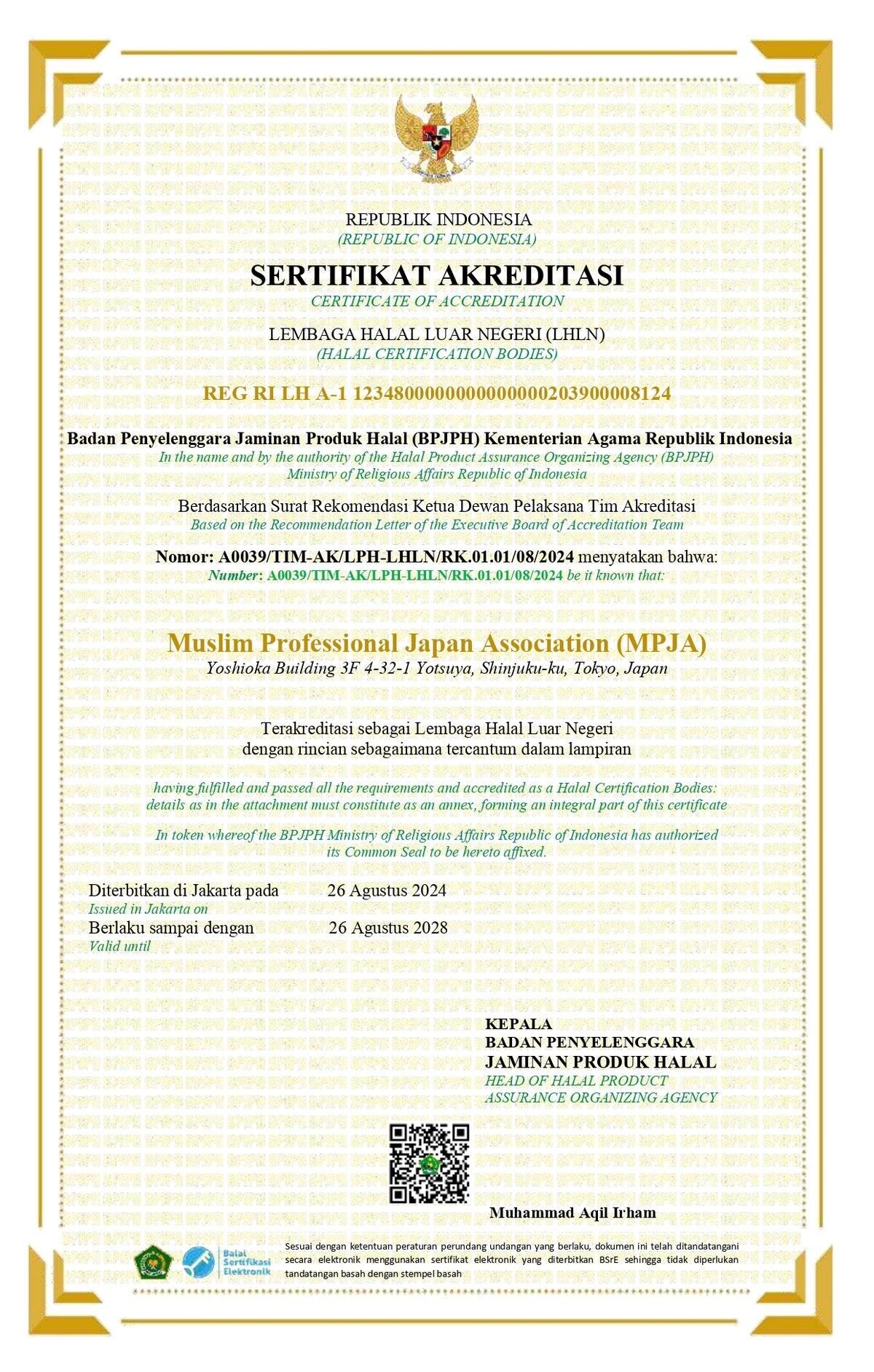
Anyone can check MPJA’s recognition status using the foreign halal certification body (LHLN) search on BPJPH’s official website.
Check MPJA in the official BPJPH directory(External website; opens in a new tab)Market Data
Market data
Muslims account for 86.7% of Indonesia’s population (2020 census).
86.7% Muslim
- Islam86.7%
- Protestant Christianity7.6%
- Catholic Christianity3.1%
- Hinduism1.7%
- Buddhism0.7%
- Other0.2%
Source: Ministry of Agriculture, Forestry and Fisheries, 2025 Export Results for Agricultural, Forestry, Fishery and Food Products by Country and Region (based on Ministry of Finance Trade Statistics)
The Gateway to the World's Largest Muslim Market